
Bonus Tract
Postmundanity for better or worse.

Welcome to Really Abstract where I post abstract street photography recorded while wandering aimlessly but aimfully, now that I’m a full-time flaneur.
In my last two posts, I wrote about how the title of the third album Quotidian Jones was truncated to mask the conceptual failure of A Joker’s Dream and a Fool’s Errand as a working title of the fourth album that became Postmundanity. The act of writing provoked the connection between the failed and the final that I hadn’t considered before. Postmundanity is a joker’s dream and a fool’s errand. Having seen it, I can’t unsee it. Having promised to write about, I feel duty bound to follow through. So, against my better judgement, here it is, for better or worse.
It bears emphasizing that I came up with the idea during a global pandemic. Daily life had changed drastically and it could be confidently intuited that it was never going back to the way it was. Given the vagaries of the subconscious mind, it is quite possible that the term postmundanity never gets coined without Covid, but that doesn’t mean that everything else that we can imagine that constitutes the postmundane condition wouldn’t still exist otherwise. It’s not merely viruses that go viral.
Like any other tease, postmundanity can’t be taken seriously, but can’t be dished out any other way. I thought it was so clever but it turned out to be too clever by half. Postmundanity is bigger than I wanted it to be, and way too big for my britches. The fact remains that I don’t want to write about such things. There are far more people, who are far more insightful, far more engaged, far more implicated, doing a far better job of it, even if they don’t call the spade a spade.
Write about what you know they say, and what I know is that all I wanted to do was to come up with an irreverent non sequitur to describe my little picture making project. That is the only postmundanity that I’m interested in writing about regardless of whether this godforsaken century has made mundanity go postal.
To wit, when the third album was still tentatively titled Quotidian Jones presents Postmundanity, I had drafted the following jeremiad to serve as an introduction:
The combination of Quotidian and Jones evokes the daily grind and common sort, two age-old themes of street photography. The Quotidian Jones Project releases albums of pictures meant to be viewed literally as photos and as metaphorical paintings, and was inspired by the effort of coming to terms with postmundanity, as identified by nugatory details blown out of all proportion while elephants in the room breed prolifically.
As we are currently living it, the contours of postmundanity are still emerging. But it is clear by now that the postmundane Zeitgeist is characterized by a narrowed focus and a heightened state. Various and sundry banalities, each literally meaningless and tangentially metaphorical, are re-contextualized into mnemonic devices for truisms that distinguish the rightful-thinking.
Losing touch with analog antecedents, postmundanity is a fully digital, cloud-based, artificially-learning machine replacement. Wetware legacy systems, reintegrated by rationalizing the magical, normalizing the mystical, and developing a surplus of literally-metaphorical factoids, fabrications and falsies, are each prone to triggering a chemical reaction by mixing a kernel of truth with a grain of salt to produce a suspension of disbelief.
With totalitarians on the left and authoritarians on the right, postmundane man is stuck in the middle but no where near the center. Disbelief suspended, trusting his gut and following his heart, he responds emotionally or loses interest (or both). Susceptible to narratives and functionally illiterate, he risks reverting to the mean or at least to meanness.
As far as I’m concerned, the Quotidian Jones Project is about mitigating the risk of reversion and meanness with high hopes of saving at least one postmundane man from himself.
As for the pictures, the Quotidian Jones Project is about chest deep and shoulder width, and as history demonstrates, that usually makes for some good street photography.
Thank goodness that working title was scrapped and this little prose-poem will never see the light of day…
I’ll wind up this screed by declining further exegesis of the premise of postmundanity, as the joker’s dream of low hanging fruit is a set up for a fool’s errand to be harvested like a punchline: That’s what Eve said. From here on in, I’ll be taking Voltaire’s advice and cultivating my own garden.
I’m looking forward to posting new albums recorded in Tours and Paris in the near future.
Until then here are a few images recorded during the pandemic when the idea of postmundanity was still a malapropism percolating in my mind’s eye. The unifying theme is that they are all pictures of windows that play with glass as a hard but fragile surface that is transparent, reflective, and invisible.
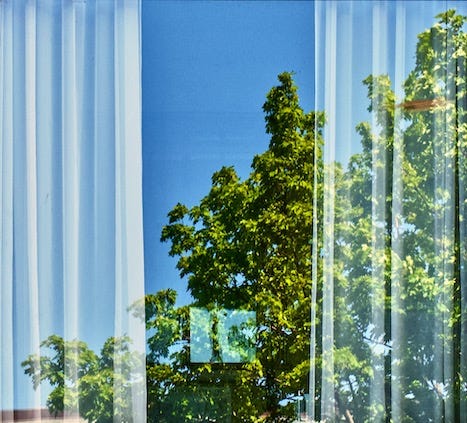
This is a picture of a window in Queen’s Park Toronto in May 2020. The odd perspective comes from the camera being between the window pane and the trees playing with the expectation that it was the other way around.
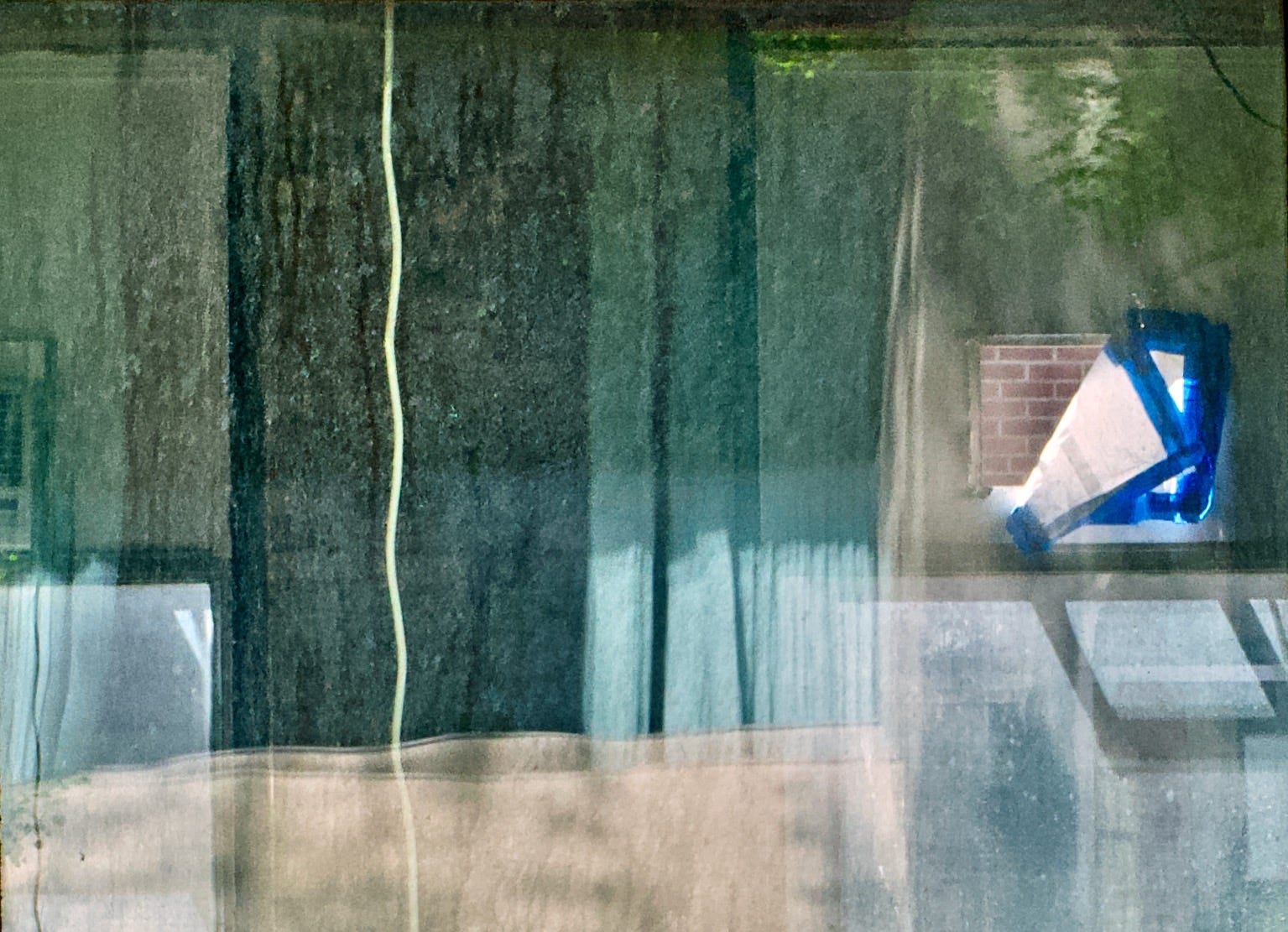
The white line in the foreground adds depth, pulling composition together by adding a counter-point to emphasize the brick wall in the background that contrasts with the reflection of the foliage to telescope time in reference to the title.
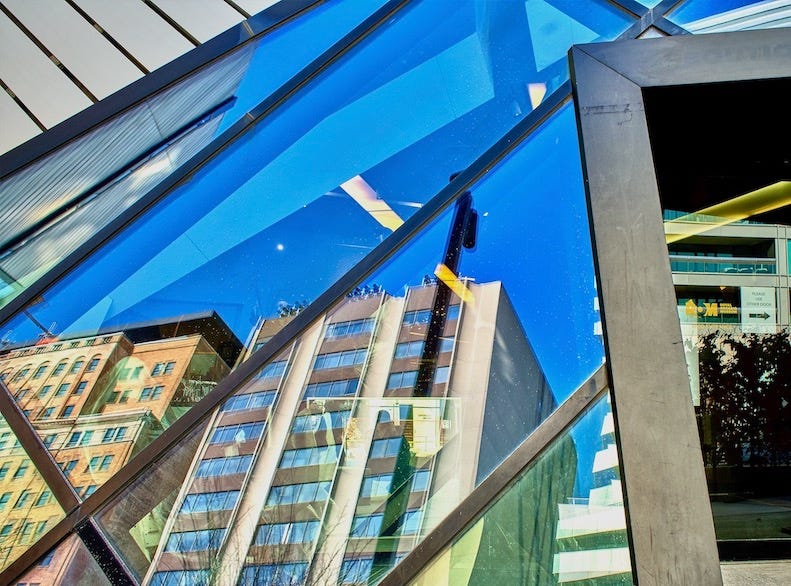
It’s a self portrait because that’s me in a crouch near the bottom of the lamppost, reflected in a mirror propped up inside the Royal Ontario Museum in March 2021. I’m hard to see and obscured by the camera, so you’ll just have to trust me.
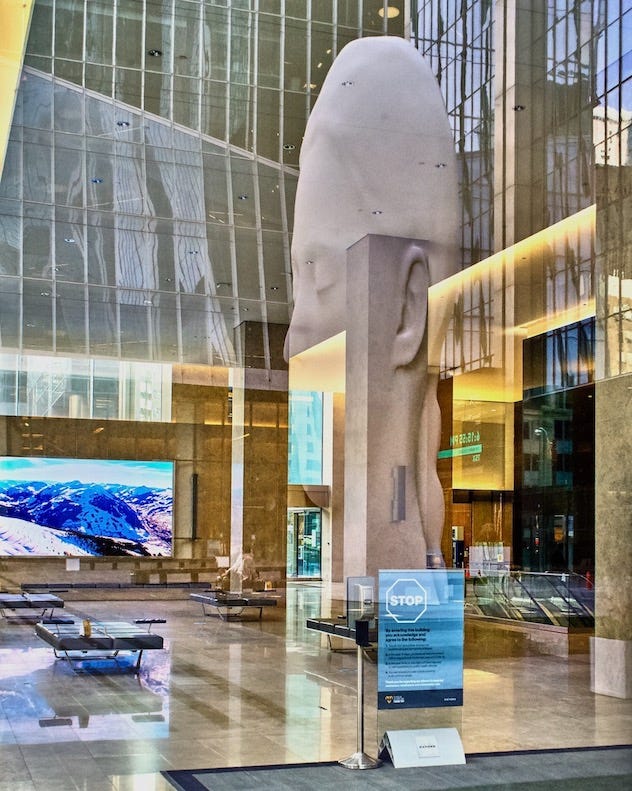
My back is turned to Jaume Plensa’s wonderful sculpture Dreaming that is installed in front of the Toronto Stock Exchange and reflected in the glass tower at 130 Adelaide West in the Financial District in March 2021.
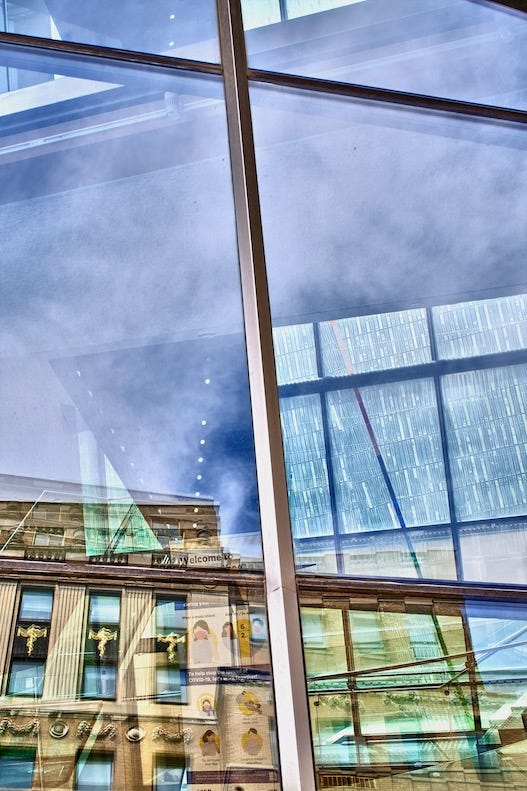
The reflection of the caduceus symbols on what is now of the University of Toronto’s Jackman Humanities Building allude to the poster outlining the Covid protocols in the Bata Shoe Museum in Toronto in May 2021. The angular lines framing the panes of glass form multiple cruciforms to complete the image.
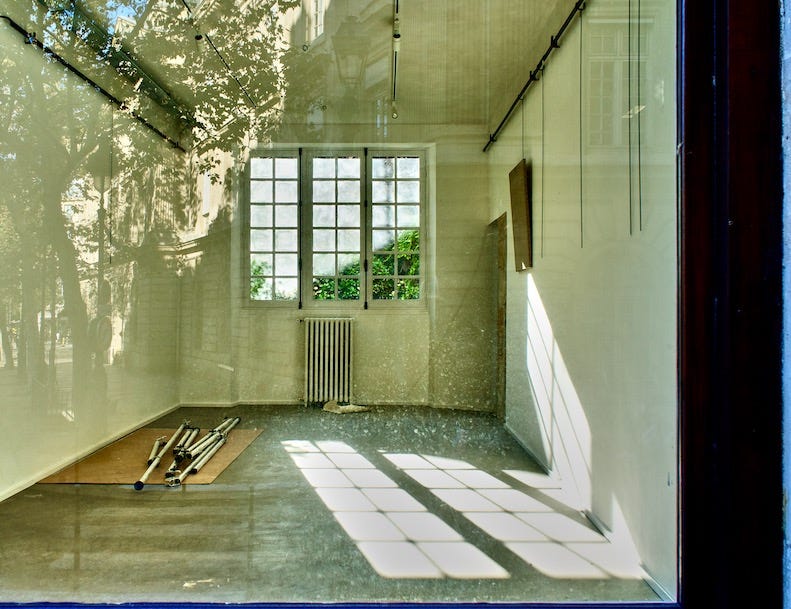
I was drawn to the three-part harmony with Paris reflected in the foreground, the shafts of light climbing the wall in the middle ground, and the windows in the background revealing a mysterious courtyard full of mist and vegetation.
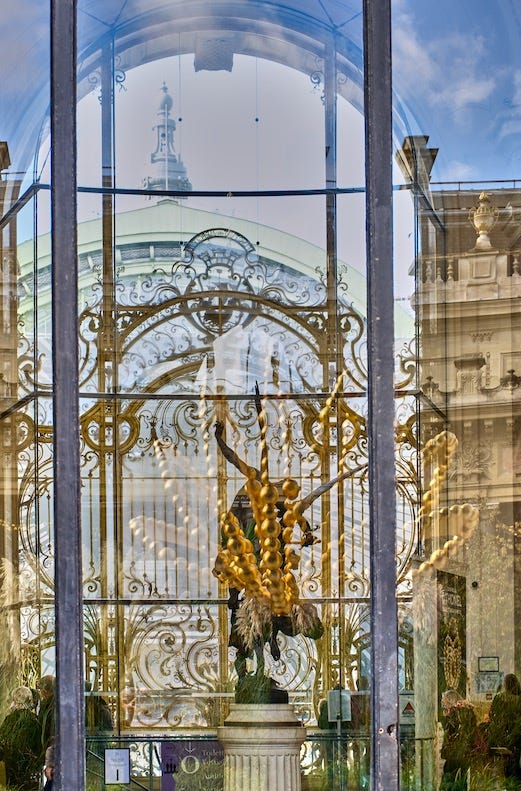
Great big fans of the brilliance and beauty of the work of Jean-Michel Othoniel, we were so ecstatic about his exhibition Le Théorème de Narcisse that we went twice in a week while visiting Paris in November 2021. Othoniel’s sculpture of a wild knot in the foreground was behind me when I recorded this view from the courtyard of the Petit Palais with the facade of the Grand Palais in the background.
Rob I’ve never seen these ones. Quite different from the ones I’m familiar with, as these feature familiar structures and features. They’re abstract, but you can make out what they’re made of.